Indiana Gov. Mike Pence shows frustration in the lack of flexibility on Medicaid plans, with the state wanting low-income participants to pay a premium towards the cost of coverage and penalize them if they don't comply. As a conservative, Pence states, “By requiring people to have that responsibility to make that monthly contribution, they really take ownership of their own health insurance and their own health care." However, on the other side, some critics say punishing low-income people is counterproductive and does not pave a positive path forward for Medicaid.
I think this topic and article is extremely interesting in illustrating a topic of division between the conservative and liberal perspectives for Indiana's plan.
Do you think Pence is justified in his requests and frustration? Personally, I understand his points and I actually do see benefits to the accountability. However, I understand the counterproductive argument and that this could restrict low-income people, seeing as this is not the intentions for Medicaid. Thus, I feel inconclusive on the argument and I'm curious on your opinions and which side of the argument you would support and why.
http://online.wsj.com/articles/indianas-gov-pence-to-press-obama-on-medicaid-plans-1412344426
Saturday, October 4, 2014

When markets fail, destruction follows
This article really captures the problems we have when we rely on markets even when we know that we are polluting the world in ways that can not be fixed. The author says we are at war with the living world.
A quote:
But why are we at war? In the rich nations, which commission
much of this destruction through imports, most of our consumption has
nothing to do with meeting human needs.
This is what hits me harder than anything: the disproportion
between what we lose and what we gain. Economic growth in a country
whose primary and secondary needs have already been met means developing
ever more useless stuff to meet ever fainter desires.
Does anyone really believe that we are producing at an efficient point? That the sum of the marginal costs of production are equal to the sum of the marginal benefits of consumption?
It's time to shout stop on this war on the living world | Environment | theguardian.com
Friday, October 3, 2014
Positive rebounds on U.S. job growth
U.S. job growth rebounded in September as the jobless rate fell to 5.9%. These articles seem overall positive, with the economy adding many jobs, the unemployment rate falling, and GDP growth. Other factors discussed in the articles include job participation rate, wage rates, confidence, discouraged Americans, and which industries are contributing to the job growth. I chose this article because this is a topic that most likely all of us are going to be interested in as we start to apply for jobs and look at employment in the future. Does this positive rebound bode well for us? Any other comments on how this topic will continue to impact you/us as we look post-grad?
http://online.wsj.com/articles/u-s-job-growth-rebounds-in-september-1412339557
http://www.nytimes.com/2014/10/04/business/economy/monthly-jobs-report-september.html?hp&action=click&pgtype=Homepage&version=LedeSum&module=first-column-region®ion=top-news&WT.nav=top-news&_r=0
http://online.wsj.com/articles/u-s-job-growth-rebounds-in-september-1412339557
http://www.nytimes.com/2014/10/04/business/economy/monthly-jobs-report-september.html?hp&action=click&pgtype=Homepage&version=LedeSum&module=first-column-region®ion=top-news&WT.nav=top-news&_r=0
Wealth is still decreasing for most Americans
Here is a graph of changes in wealth for the medium family and those at the top of the income and wealth distribution. Changes in wealth mirror those in income. Those at the top have more than recovered since the great recession; the majority of Americans have not.

One Step Up & Two Steps Back « The Berkeley Blog
One Step Up & Two Steps Back « The Berkeley Blog
Fracking Companies Fight EPA's Proposed Chemical Disclosure Rules - Scientific American
This reads like a textbook example of regulatory capture with respect to externalities.
Fracking Companies Fight EPA's Proposed Chemical Disclosure Rules - Scientific American
Fracking Companies Fight EPA's Proposed Chemical Disclosure Rules - Scientific American
Power and the income distribution
A chart relating income gains and economic growth or recovery after recession has been in the news in the past two weeks:
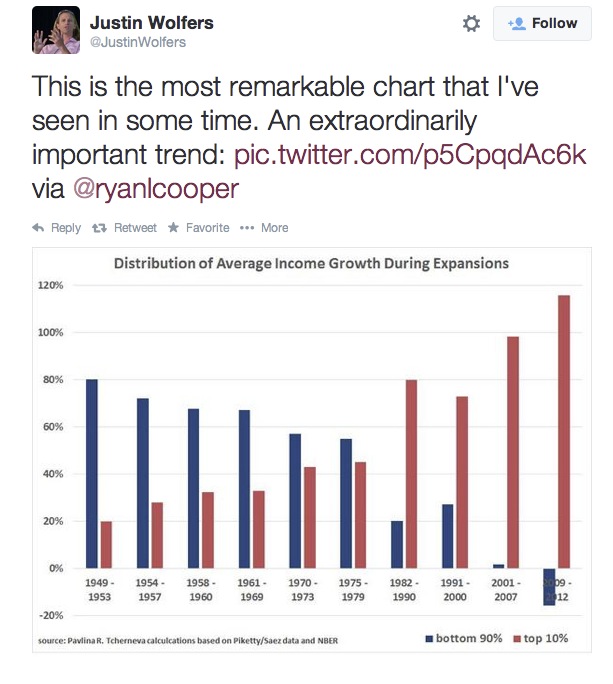
Wray argues that monetary and fiscal policy used during the recessions was geared to helping the wealthy at the expense of everyone else. He writes:
In the latest calamity, we had tens of trillions of dollars of
attention paid to rescuing our top tenth of a percent on Wall Street,
and mere peanuts thrown at Main Street. In other work, Pavlina has
documented that the “fiscal stimulus” was not aimed at those who
suffered the most; and students of mine, namely Andy Felkerson and
Nicola Mathews showed that Uncle Ben originated well over $29 trillion
in low interest rate loans to rescue Wall Street. (Go here for papers on
this project: http://www.levyinstitute.org/ford-levy/governance/) No wonder that when the economy began to recover, our One Percenters
captured more than all the gains. They are rich and powerful, and Uncle
Sam directed almost all his efforts to them.
As Hyman Minsky argued back in the 1960s, if you want to reduce
poverty you must include job creation as a central component of your War
on Poverty. He (correctly) predicted that the Kennedy-Johnson War on
Poverty would fail because it did not contain such a program.
Further, he argued that once you’ve provided jobs to all who want to
work, you need to gradually shift the distribution of income toward the
bottom. You do that by holding down income growth at the top while
gradually increasing pay at the bottom.
Randy Wray: Rising Tides Lift All Yachts – Why the 1% Grabs all the Gains From Growth | naked capitalism
Thursday, October 2, 2014
Multiple perspectives on refugee status plan
In two articles, one from WSJ and the other from NYT, the topic of the U.S. offering Central American children the opportunity to apply for refugee status is discussed. It is interesting to read on the differing perspectives, specifically between human rights activists and activists who call for a tough stance on illegal immigration. Some examples on the differing opinions from the articles:
From WSJ, "Activists who call for a tough stance on illegal immigration criticized the Obama administration's move. 'The president's plan undermines his contention that his administration is determined to return the thousands of recent illegal aliens from those Central American countries,' said Ira Mehlman, a spokesman for the Federation for American Immigration Reform, which favors curbing all immigration to the U.S.
From NYT, "Human rights advocates have largely praised the idea, saying the plan would help protect children who are facing rape and even death at the hands of drug trafficking gangs that have become more prevalent in some parts of Central America."
These are just a couple of many differing points on the plan between groups. What do you think of it?
http://online.wsj.com/articles/u-s-to-offer-refugee-status-to-some-children-from-central-america-1412139819?KEYWORDS=central+america
http://www.nytimes.com/2014/10/01/us/obama-approves-plan-to-let-children-apply-for-refugee-status-in-central-america.html?ref=politics
Subscribe to:
Posts (Atom)